TPEs: The Growing Trend of Their Usage in the Automotive Industry
TPE use in vehicles keeps rising because shared global platforms reward a small number of tunable, recyclable material families that can serve interior, exterior and under-the-hood parts at once.
The automotive industry has witnessed a significant surge in the utilization of Thermoplastic Elastomers (TPEs). This trend encompasses various TPE types, including Thermoplastic Vulcanizates (TPV) and Thermoplastic Olefins (TPO), along with other elastomeric materials, offering immense potential for the sector.
The global platform strategy
Over the past decade, major automotive players have shifted their strategies dramatically. Since 2009, the industry has embraced the Global Platform strategy as a pivotal approach to curtail production costs and enhance efficiency. This strategy aims to reduce technical and dimensional disparities among various automotive components. It is exemplified by the practice of producing multiple car models using shared components such as engines, gearboxes, and chassis. For instance, General Motors successfully reduced its platform count from 30 to 18 between 2010 and 2018.
TPE share of automotive plastics
Raw materials used in manufacturing parts for these shared platforms are categorized into limited groups. Notably, approximately 25% of plastics in car part production are Polypropylene (PP). Within this context, general Thermoplastic Elastomers (TPEs) fall within the purview of the broader PP portfolio. Their exceptional properties make them crucial in increasing the polymer usage proportion in car part production.
Polyolefin TPE in vehicle components
Modern TPEs encompass a diverse array of polymers, each with unique characteristics. These properties stem from the mixing of base polymers, elastomeric phase, and a varied spectrum of additives tailored to the final product application. Polyolefin-based TPEs, including Polyethylene (PE) and Polypropylene (PP), play a prominent role in car part manufacturing. Their prevalence is attributed to several factors:
- Cost efficiency
- Adjustable stiffness-flexibility ratios
- Surface property customization
- Softness
- Foaming ability
- Recyclability
- Reduced environmental impact
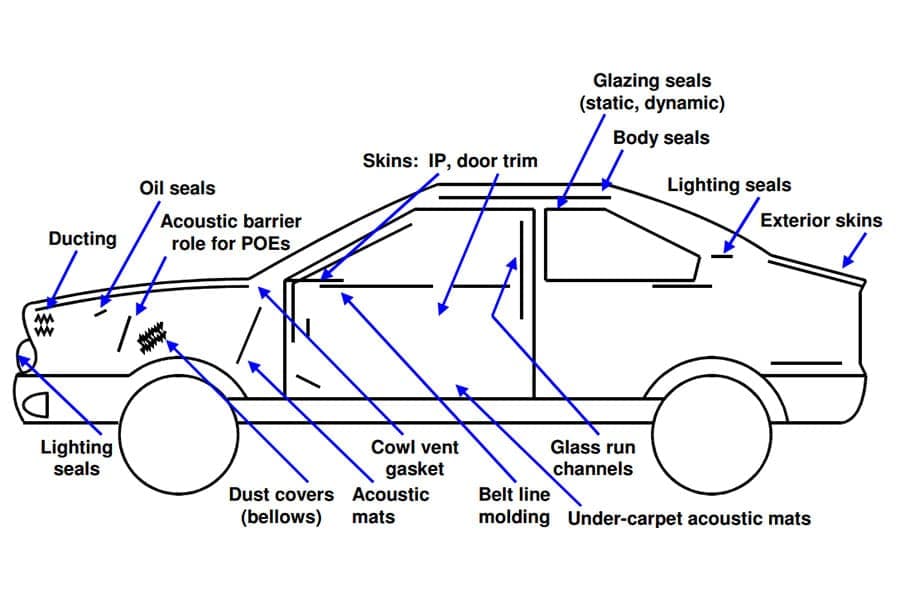
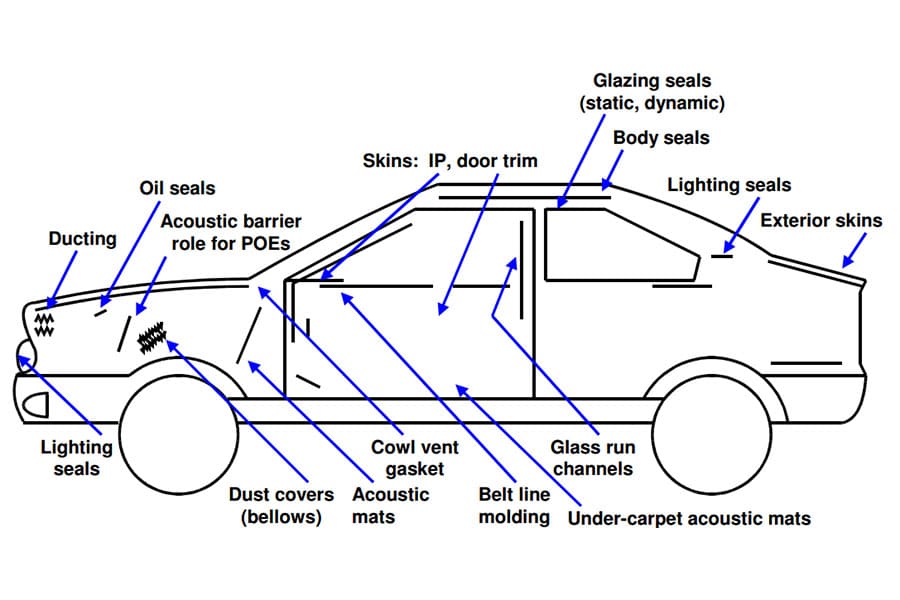
Consequently, these Polyolefin TPEs find extensive use in exterior, interior, and under-the-hood components. Applications range from car bodies to bumpers, door sealing strips, airbag assemblies, dashboards, door covers, steering wheels, ventilation system valves, carpets, insulation, pipes, ducts, dust collectors, wire covers, and more.
Processing methods
Moreover, Thermoplastic Elastomers (TPEs) can be processed using various methods, including:
- Injection molding
- Blow molding
- Extrusion
- Over-molding
A comprehensive visualization of the myriad uses of TPEs within a car is typically depicted in accompanying figures or diagrams.
FARRPRENE GRADES
Grades commonly specified for automotive applications
| GRADE | HARDNESS | TENSILE (MPa) | TYPICAL USE |
|---|---|---|---|
| EF651AExtrusion / Filled | 65 Shore A | 7 | Door/window weatherstrip and glass-run profiles (extrusion) |
| EF655AExtrusion / Filled | 65 Shore A | 5 | Sealing and trim profiles (extrusion) |
| IF801AInjection / Filled | 80 Shore A | 10 | Firm pedal pads, grommets and load-bearing flexible parts |
Typical average values from a limited sample set; not a formal specification. Request the signed datasheet for current values.
MORE INSIGHTS
View All Articles