TPE FOR AUTOMOTIVE
Driving the future with custom-engineered compounds that redefine performance.
Lightweight Solutions, Heavy-Duty Results
Experience the perfect balance of resilience and comfort in every step. Our innovative TPE compounds for car mats deliver superior durability and performance while keeping your vehicle’s interior light and sleek.
Grip Meets Comfort
Our TPE raw materials ensure car mats that combine non-slip safety with plush underfoot feel.
OUR MISSION
We engineer tailored TPE compounds that exceed automotive standards, propelling the industry forward through innovative, high-performance solutions.
OUR RANGE OF PRODUCTS
| Farrprene grades | Typical automotive parts | Key property targets for that part | Why the grade meets them |
|---|---|---|---|
| 20 A | Steering-column grommets, seat comfort pads, anti-squeak inserts | • Ultra-soft feel & high damping (≤ 25 Shore A) • ≥ 600 % elongation to resist tearing • Low density for weight saving | 20 A hardness, > 800 % elongation and ≈ 0.88 g cm-³ specific gravity deliver maximum compliance and energy absorption; very-soft TPEs in this range are the industry norm for NVH cushions and comfort foams. |
| 45A grades IU45A IF45A | Thumb wheels, HVAC-flap edge dampers, cable boots | • Mid-soft 40–50 A for vibration isolation • Good fatigue life • Over-mouldability to PP/ABS | 45 A hardness with > 800 % strain and a moderate melt flow (≈ 2.5–4.5 g / 10 min) suits injection over-moulding; the same hardness window is widely specified for interior damping clips and flexible boots. |
| 65A grades for injection IU65A IU65A2 IF65A IF65A2 | Door-switch bezels, cup-holder mats, interior grips | • Soft-touch 55–65 A • Low VOC / fogging • Reliable adhesion to PP/ABS | 65 A hardness, > 800 % stretch and low density (0.88–1.06 g cm-³) give a pleasant touch while meeting interior emission targets; SEBS chemistry bonds directly to PP and ABS in two-shot moulding. |
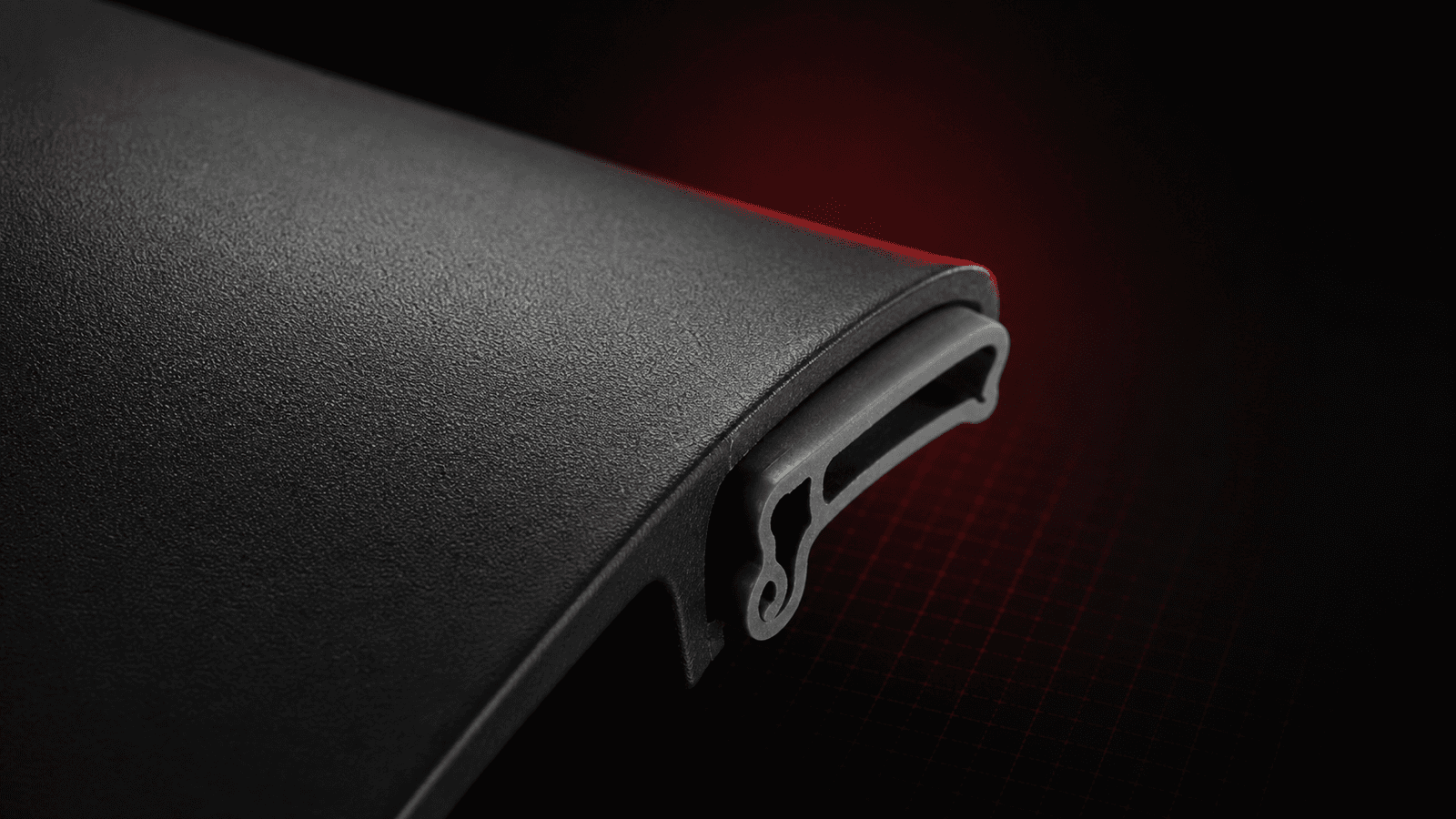
| 65A grades for extrusion EF650 EF651 EF652 | Door & window weather-strips, glass-run channels | • 60–70 A hardness for sealing force • Very low melt flow (≤ 0.8 g / 10 min) for profile stability • Good tear & ozone resistance | These grades supply 65 A hardness with melt-flow as low as 0.08 g / 10 min, ensuring dimensionally precise extruded profiles; the durometer and tear performance align with standard automotive TPE weather-strip products. |
| 70A for extrusion EF700 | Belt-line seals, cowl gaskets, exterior sill seals | • Stiffer 70 A for compression-set control • Ultra-low flow (~0.01 g / 10 min) for thick or co-extruded profiles | EF700 offers 70 A hardness alongside extremely low melt flow, maintaining shape in complex multi-durometer seals where dimensional accuracy and long-term sealing force are critical. |
| 85A grades IF85A EF85A | Air-bag covers, brake/accelerator pedal pads, step pads & anti-slip mats | • High hardness 80–90 A for abrasion resistance • Tear strength ≥ 20 kN m-¹ • Heat & UV stability • Bonding to PP for two-shot parts | Farrprene 85 A grades combine > 800 % elongation with tensile strength up to 12 MPa (injection grade) and high tear resistance (extrusion grade), suiting demanding safety parts such as air-bag doors, pedal trims and exterior step pads. |
FIND OUT THE LATEST IN AUTOMOTIVE TPE
Our Blog
Thermoplastic Elastomers (TPEs): An Effective Solution for Preventing Water Penetration
Thermoplastic Elastomers (TPEs) play a crucial role in preventing water penetration, which is essential for combating rust, decay, and prolonging the lifespan of cars. Water leakage into a car’s
(TPEs) Thermoplastic Elastomers: Suitable Raw Materials for Car Interior Decoration
TPEs play a significant role in the decision-making process when purchasing a car, as customers increasingly consider factors such as: In recent years, cabin comfort and interior design features
TPEs: The Growing Trend of Their Usage in the Automotive Industry
The automotive industry has witnessed a significant surge in the utilization of Thermoplastic Elastomers (TPEs). This trend encompasses various TPE types, including Thermoplastic Vulcanizates (TPV) and Thermoplastic Olefins (TPO),