Thermoplastic elastomers (TPEs) are widely known for their versatility and range of applications, making them essential in numerous industries.
These materials combine the best qualities of elastomers and plastics, offering flexibility, durability, and ease of processing. The diversity of TPEs arises from their chemical structure and manufacturing methods. These factors allow for tailored properties depending on the desired application. Thermoplastic elastomers
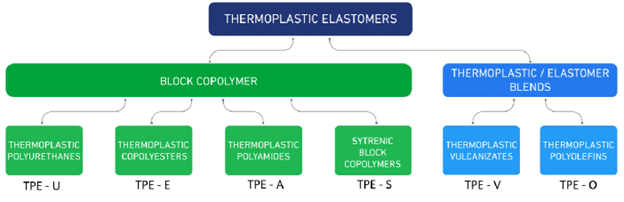
are generally categorized into two main groups: blend Thermoplastic elastomers and block-copolymer Thermoplastic elastomers.
Blended TPEs
Blended Thermoplastic elastomers are created by physically combining two different polymers. One polymer forms the hard phase, while the other forms the soft, rubbery phase.
This is achieved through melt mixing in an extruder, a process that ensures uniform blending of the materials. Blended Thermoplastic elastomers offer the advantage of being easy to process while providing excellent elasticity and mechanical strength. Among the most widely used blended Thermoplastic elastomers is TPE-O, which is based on polyolefin materials. Additionally, TPE-V, a subtype of blended Thermoplastic elastomers, features a cured soft phase, offering enhanced compressive strength compared to TPE-O. This makes TPE-V suitable for applications that require greater durability and resistance to deformation under pressure.
Block Copolymer TPEs
In contrast to blended Thermoplastic elastomers, block copolymer Thermoplastic elastomers are synthesized chemically in reactors. This process involves polymerizing two or more different monomers.
These monomers are arranged in blocks along the polymer chain, with each block contributing different properties. In block copolymer Thermoplastic elastomers, one block forms the soft phase, while the other forms the hard phase. This arrangement allows for improved control over the material’s mechanical properties, particularly in terms of flexibility and strength.
Among the block copolymer Thermoplastic elastomers , styrene-based materials are the most widely used. These styrenic block copolymers combine a hard styrene segment with a soft segment such as ethylene, propylene, or other olefins. These materials offer good processability and performance in a wide range of applications. Additionally, some block copolymer TPEs, such as TPE-A, TPE-E, and TPE-U, are designed for more demanding applications. These Thermoplastic elastomers are classified as engineering thermoplastic elastomers due to their higher thermal performance and enhanced mechanical properties.
• TPE-A: Based on polyamide segments, TPE-A offers high strength and heat resistance, making it suitable for automotive and industrial applications.
• TPE-E: Made from polyester segments, TPE-E provides excellent chemical resistance and thermal stability, which makes it ideal for applications in the medical and electronic sectors.
• TPE-U (TPU): Thermoplastic polyurethanes (TPU) are widely used in automotive and household appliances due to their outstanding wear resistance, toughness, and high-performance characteristics.
Conclusion
Thermoplastic elastomers (TPEs) are a versatile and highly adaptable group of materials, offering solutions to various application challenges across many industries. Understanding the distinctions between blend Thermoplastic elastomers and block copolymer Thermoplastic elastomers , as well as their respective subgroups, is essential for selecting the most suitable material for specific needs. With the ability to engineer Thermoplastic elastomers for a variety of mechanical, thermal, and chemical properties, they continue to be an essential component in a wide range of applications, from automotive to medical devices and beyond.